
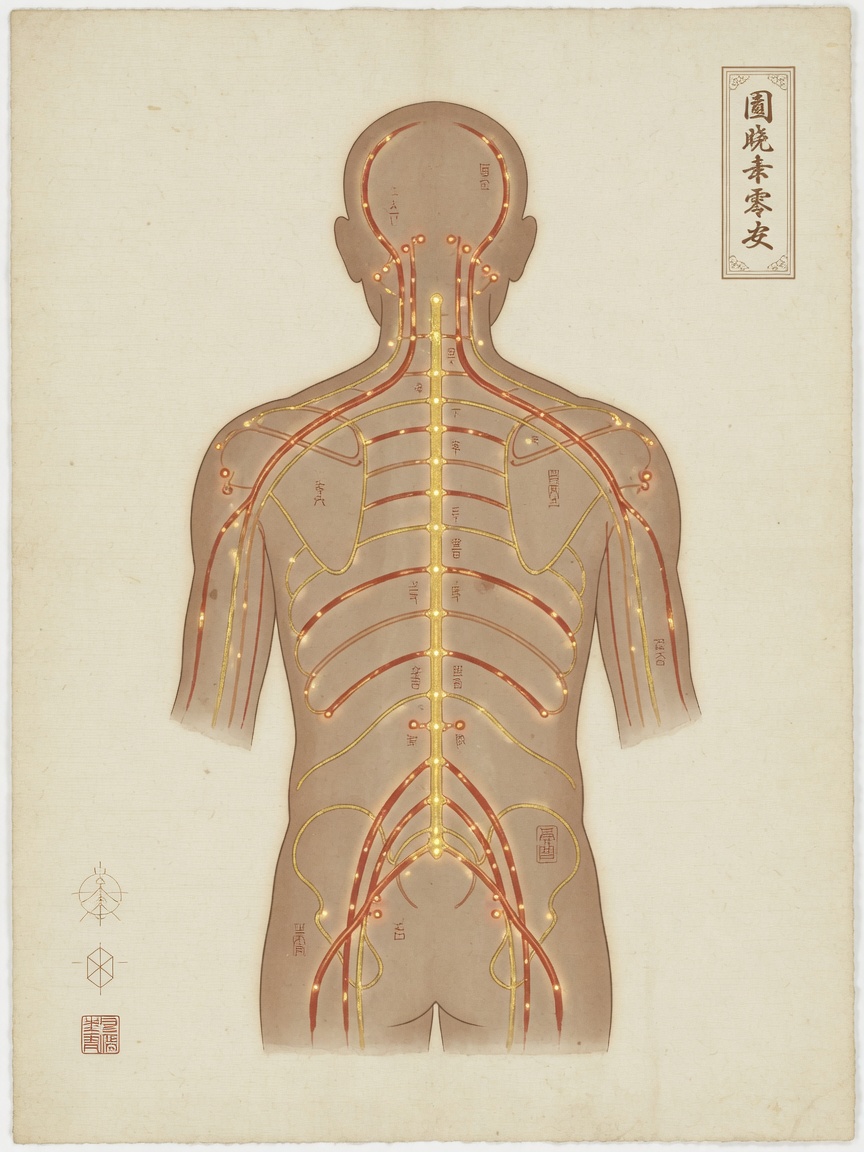
Bladder channel of the back
The Foot Taiyang Bladder channel runs in two lines parallel to the spine. It is the most common cupping highway in Chinese medicine. Shu (transport) points along this channel relate to zang-fu organs; cupping here can address both local bi pain and broader pattern strategies (for example, upper-back work for exterior Lung-related patterns).
Governing Vessel (Du mai)
The midline of the back follows the Governing Vessel. Practitioners may cup near—but carefully around—the spine. Cups are not forced onto spinous processes; soft tissue beside the midline is preferred.
Common regional strategies
| Region | Typical TCM intent | Notes |
|---|---|---|
| Upper back / nape | Release exterior, expel wind-cold, ease Taiyang stiffness | Classic for early colds and wind invasion |
| Shoulder & scapular region | Move local qi/blood; channel bi | Often with ashi points |
| Mid-back | Organ-related back-shu area strategies; constraint | Pattern-dependent |
| Lumbar region | Kidney/low-back bi; cold-damp; stasis | Very common retained-cup area |
| Posterior thigh / gastroc | Bladder channel bi; sports strain as stasis | Moving cups frequent |
Ashi points
Beyond textbook points, practitioners cup where the patient says “that’s the spot”—ashi. In practice this overlaps with trigger-point and tight band findings, framed as local stagnation in the collaterals.
Areas generally avoided or restricted
- Broken skin, infection, open wounds
- Major vessels of the anterior neck
- Abdomen and lumbosacral region in pregnancy (practitioner-guided)
- Over fractures, ulcers, or severe varicosities
- Eyes, soft hollows of the face (facial cupping is a specialized skill)
Channel + constitution
Placement is never only a chart. Age, deficiency/excess, season, and concurrent acupuncture points all influence where and how strongly cups are applied.